
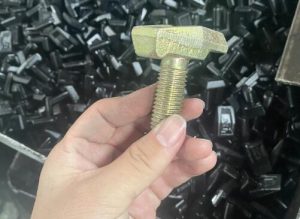
Elevators in offices, homes and shopping centres operate under substantial loads. Guide rail clip connections must remain secure during service. Anti-loosening measures form part of the fastening design.
Do Guide Rail Clips Need Anti-Loosening Measures?
Sustained vibration and impact can loosen an unsuitable bolted connection. The fastening arrangement should therefore include the anti-loosening measures required by the elevator design.
The Chinese article describes clip bolt assemblies with flat washers, spring washers and nuts. T1, T2, T3, T4 and T5 models use different component sizes, so matching hardware and assembly requirements must be followed.
Contact Xinyi’s engineers if you are unsure which components are required. Do not substitute hardware without checking the design requirements.
Common Methods Described in the Source
Spring washers. The original article describes elastic deformation and friction as the means by which a spring washer helps resist loosening. Use washers only as specified for the actual joint; the complete connection design determines their suitability.
Double nuts. A second nut is tightened against the first to create a locking arrangement. The source mentions using one thin and one full-height nut. The order and tightening procedure must follow the approved assembly instructions.
Locknuts. These use a locking feature to resist rotation. For example, a nylon-insert locknut incorporates a nylon ring that deforms around the mating thread and increases resistance to loosening.